1/3 Buzand Str., Yerevan 0010, RA
The town of Zhvanets is located in the Kamianets-Podilskyi district of the Khmelnytskyi region of Ukraine, approximately 24 km southwest of Kamianets-Podilskyi. It is a small, picturesque settlement on the banks of the Dniester River.
Armenians began arriving in Zhvanets from Moldavia and Wallachia in the 1670s. During that period, about 100 Armenian families lived here. As a result of the Turkish invasion of 1768, the Armenians relocated to Kamianets-Podilskyi. By the end of the 18th century, when the territory was incorporated into the Russian Empire, only 28 Armenians remained in Zhvanets (Vardanyan, p. 60).
Armenian lapidary inscriptions in Zhvanets have not survived. Neither has the cemetery by the Armenian church.
Among the Armenian monuments of Zhvanets, the following are mentioned:
1. The old wooden church.
2. The new stone church, built in the 18th century.
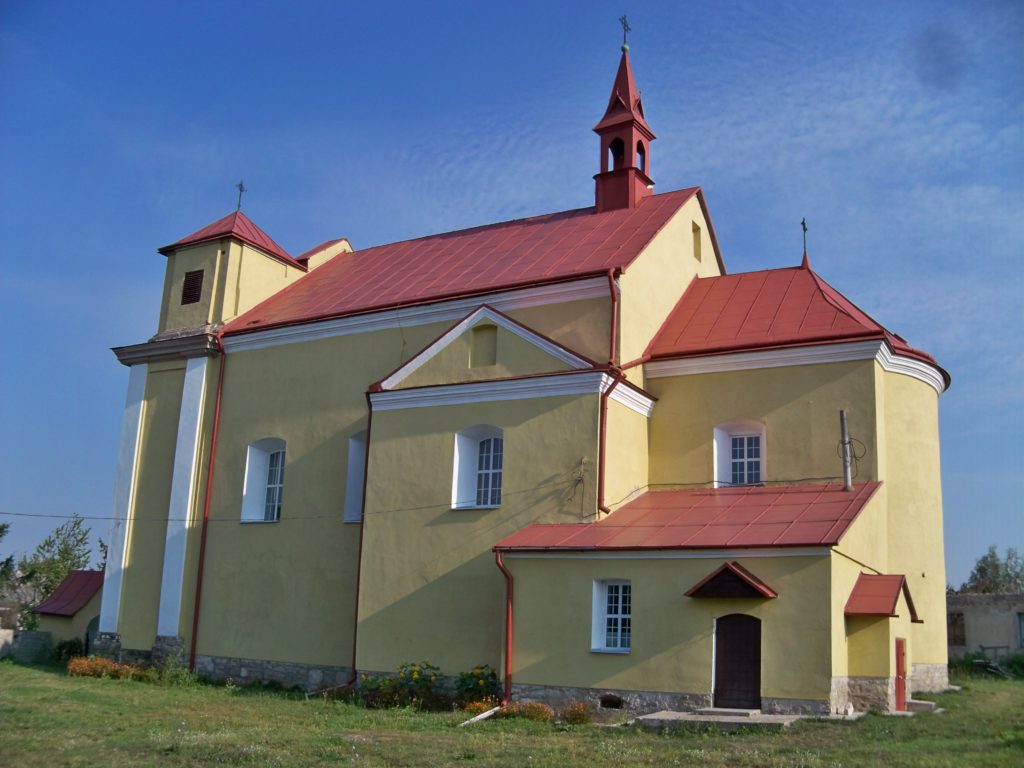
The Armenian community of Zhvanets initially had a wooden church, instead of which a stone one was constructed at the beginning of the 18th century. The construction was led by the local clergyman Grigor Hankevich, who was subsequently buried in this church.
Father Minas Bzhshkyants wrote about this church: “The Armenian church is beautiful, moderately large and high, built in the Ionic style, and has six altars” (Bzhshkyants, pp. 210–211).
The church, which was substantially damaged as a result of the Turkish invasion of 1768, was thoroughly rebuilt in 1791 and consecrated by Jan Tumanowicz, the Armenian Catholic Archbishop of Lviv. The church had six altars dedicated to the Holy Mother of God (Blessed Virgin Mary), Saint Grigor (Gregory), Saint Cayetan (Cajetan), Saint Anton (Anthony), Saint Thaddevos (Thaddeus), and Saint Bardughimeos (Bartholomew) (Vardanyan, p. 60).
At the beginning of the 19th century, the Armenian church in Zhvanets passed to the Polish Catholic Church. By that time, the Armenian community had already been assimilated (Bzhshkyants, p. 210).
In the Soviet years, the church and its surrounding fortification walls were converted into an agricultural machinery service centre. Following Ukraine’s independence, the church was returned to the Polish Catholic community.
References
1. Father Minas Bzhshkyants, Travel to Poland, Venice, St. Lazarus, 1830.
2. Sahak Vardanyan, Armenian Monuments of Western Ukraine, RAA (Research on Armenian Architecture), Vardzk, No. 9, 2013.